





Bentley ProjectWise Alternatives for Engineering Teams in 2026
Compare 7 ProjectWise alternatives on version control, approvals, transmittals, and interoperability, with pros and cons from user reviews.


TL;DR
- Bentley ProjectWise offers strong revision control and multi-firm design collaboration, but reviewers complain of a dated interface, complex workflow setup, and limited non-Bentley integrations.
- Replacing ProjectWise is an information-governance and interoperability decision, so compare revisions, approvals, transmittals, permissions, open formats, and migration paths first.
- CUBE suits mid-market engineering teams that want browser access to CAD and BIM files, version-tied approvals, transmittal records, and simpler administration.
- Autodesk Forma suits Autodesk-standardized teams, while Oracle Aconex and Asite suit large owner programs that need one controlled multi-party record.
- Newforma Konekt suits design firms whose project record lives in email, and Dalux and Trimble Connect lead on shared models.
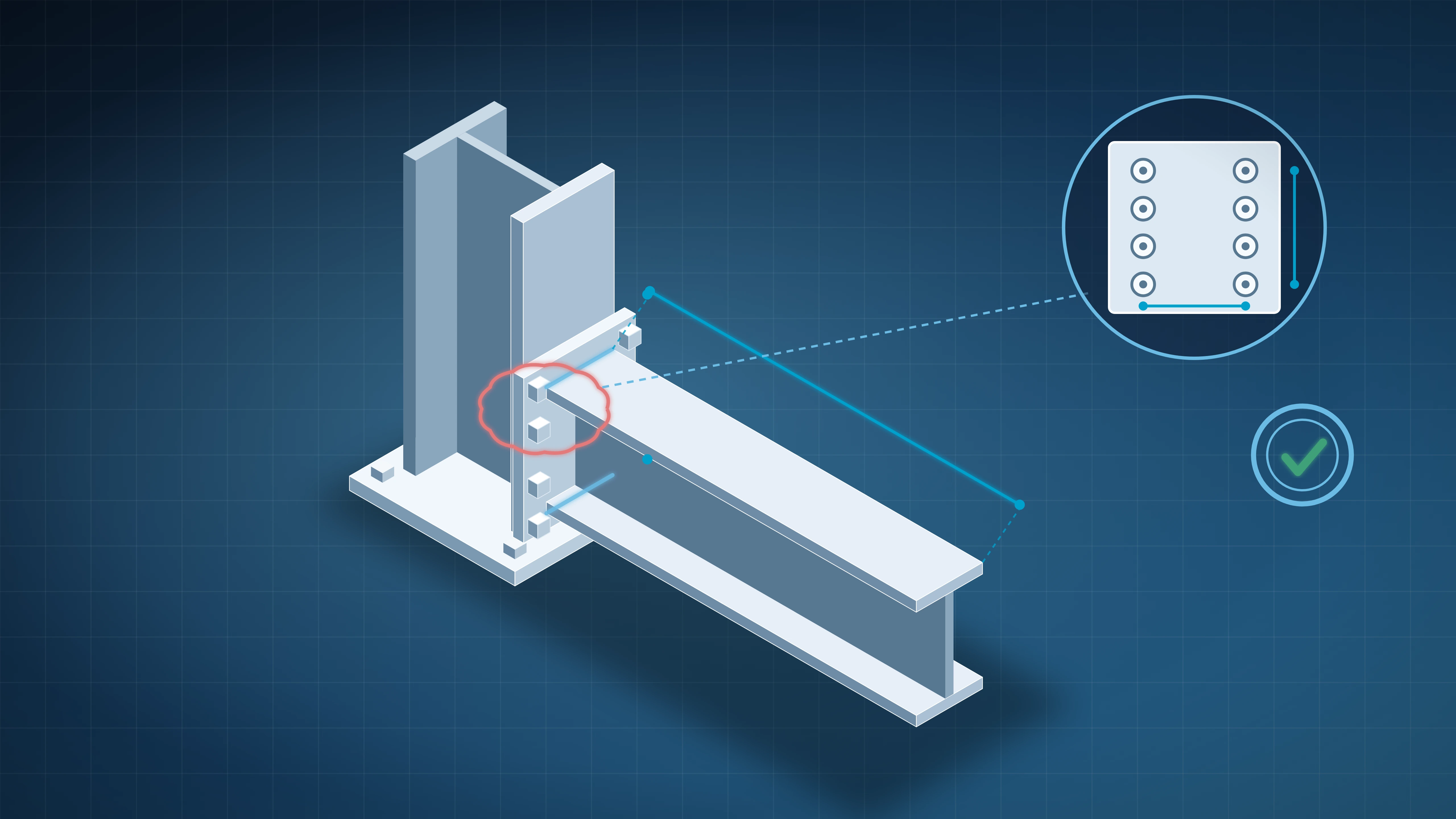
Bentley® ProjectWise® is built for infrastructure design. It manages engineering work-in-progress with design application integration, reference file management, and controlled workspaces, and it handles deliverables across the supply chain.
However, the fit changes outside large Bentley-centered programs. Reviewers describe a steep learning curve, a desktop client that can feel slow, and workflow setup that's hard to change. One reviewer notes that integrations depend on what Bentley chooses to support.
Teams compare ProjectWise alternatives for three reasons: simpler administration, browser access for every firm, and open formats beyond one vendor's stack. CUBE, Oracle® Aconex®, and Asite® lead on document governance. Autodesk Forma® suits Autodesk®-centered teams, Newforma Konekt® organizes email-driven project records, and Dalux® and Trimble Connect® lead on shared models.
This guide compares seven Bentley ProjectWise alternatives, including CUBE, on version control, approvals, transmittals, permissions, interoperability, and migration.
Best ProjectWise Alternatives at a Glance
Each alternative below answers a different reason for leaving ProjectWise, so start with the row that matches yours.
Why Teams Evaluate a Switch from ProjectWise
ProjectWise earns its place on large infrastructure programs that design in Bentley applications. Reviewers credit its revision workflows and the way several firms can work on design files in one shared location. The pressure to switch usually comes from fit, and four reasons appear most often.
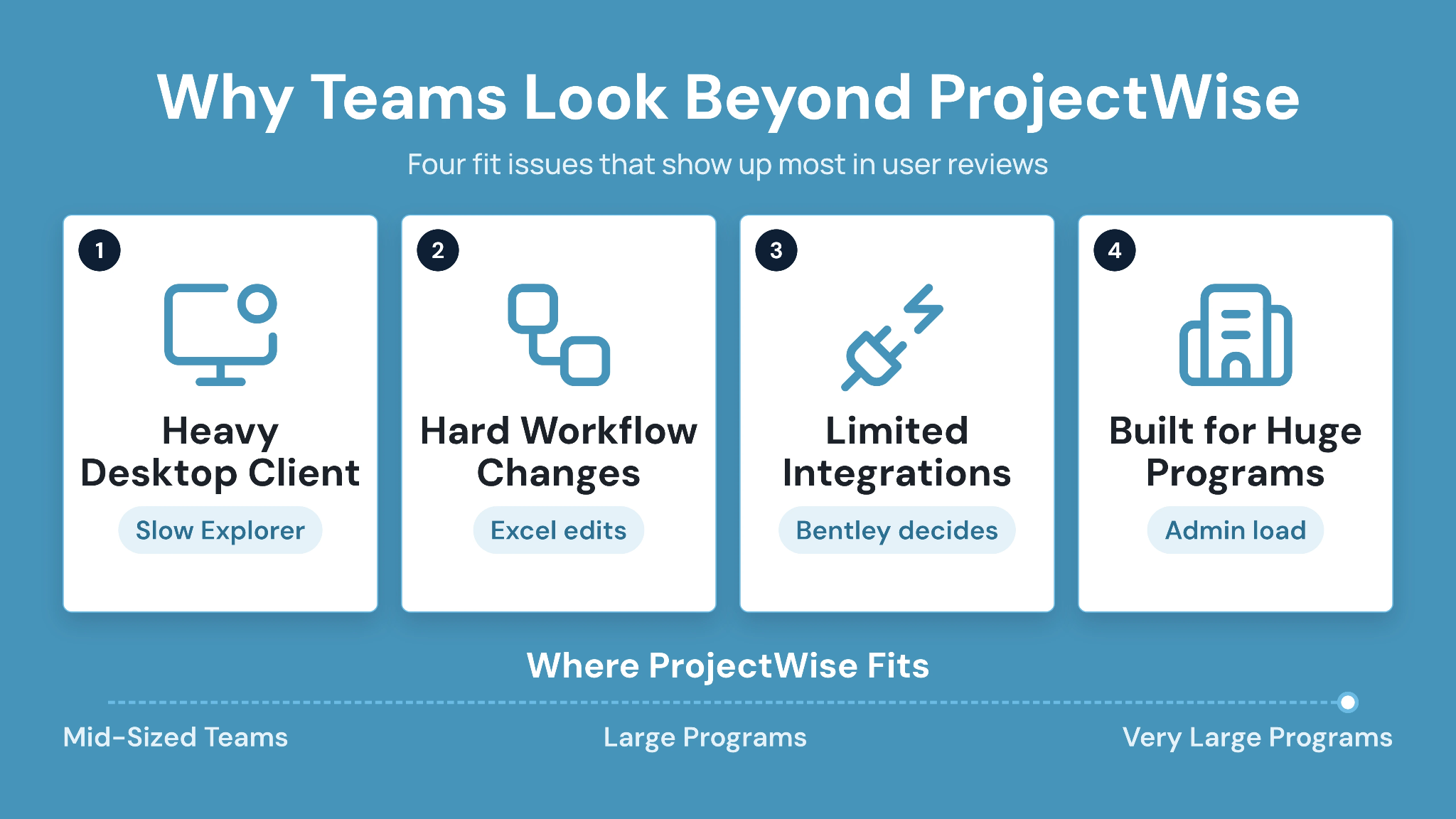
1. The interface and desktop client feel heavy
On G2®, one reviewer says the web interface looks like an old platform, and another finds ProjectWise Explorer slow. Software Advice reviewers® describe a steep learning curve and a complex interface for new users.
2. Workflow changes need specialist effort
Reviewers call workflow configuration difficult. One describes editing workflows through an Excel file as the hardest part of running the system.
3. Integrations depend on Bentley
A TrustRadius reviewer notes that integration depends on whether Bentley supports your software. Exporting to another system works, but it takes time and means relinking file locations.
4. The platform suits very large programs
The same reviewer sees ProjectWise as best for very large projects with many team members. A mid-sized engineering firm with a small admin team may carry more platform than its projects need.
These points make ProjectWise a harder fit when your team works across design tools, often onboards new firms, and runs its own administration.
How We Compared ProjectWise Alternatives
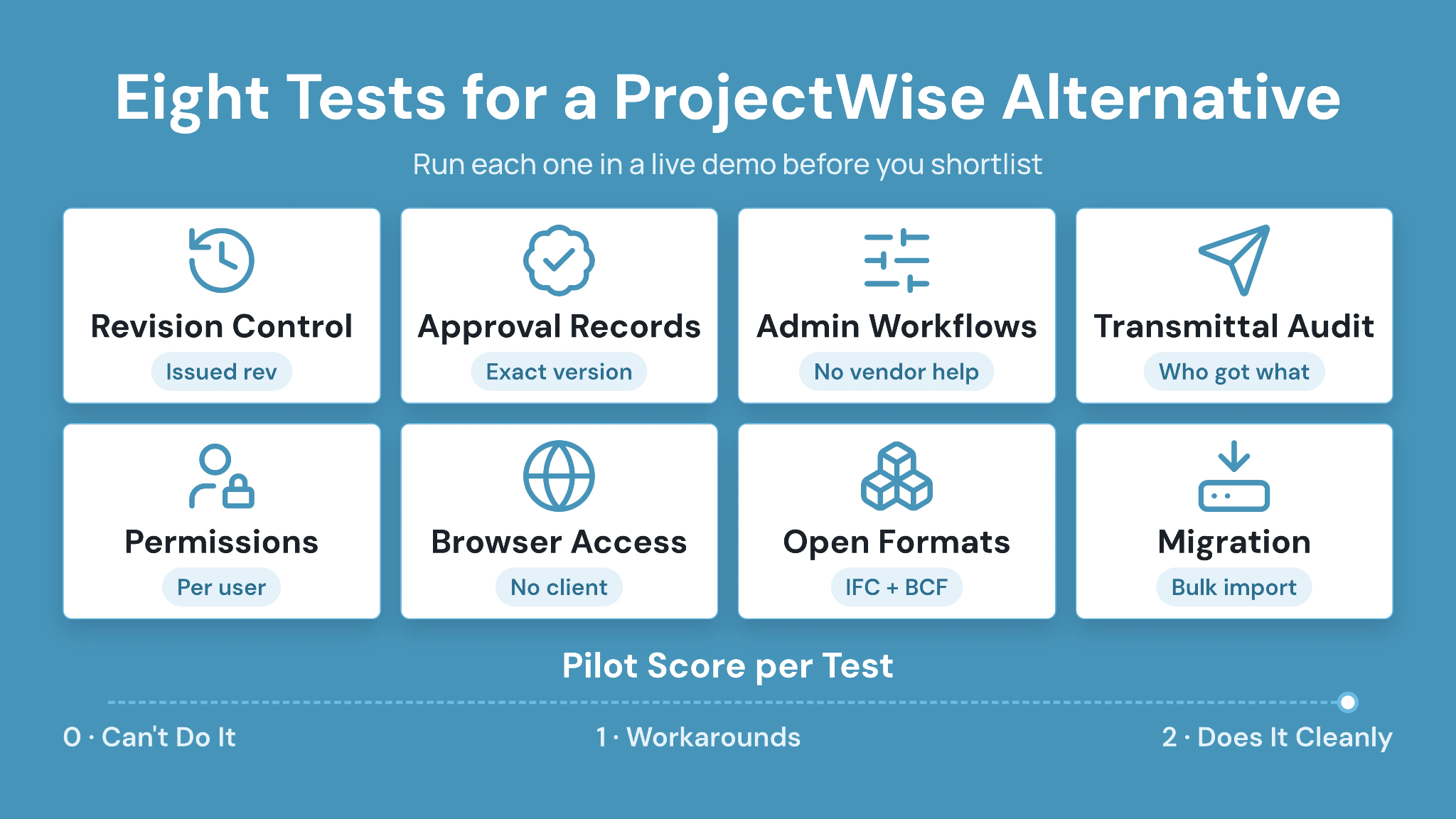
A ProjectWise alternative must keep engineering information controlled and readable across every firm. We compared each platform on eight governance and interoperability criteria. Features come from each vendor's own pages, and strengths and tradeoffs reflect recurring themes in G2 and Capterra® reviews from 2023 onward.
The 7 Best ProjectWise Alternatives Compared
CUBE answers most of the reasons teams leave ProjectWise, with browser access for every firm, admin-configured approvals, and open formats. Oracle Aconex and Asite suit owner programs, Autodesk Forma suits Autodesk-centered teams, and Newforma Konekt organizes email-driven records. The sections below cover each platform in detail.
1. CUBE: Best for Governed Engineering Records With Less Administration
CUBE overview
CUBE is a construction project management platform that pairs a common data environment with a Project Management product. Every firm works in the browser, where CAD and BIM files open without a desktop client. Admins shape approvals, statuses, and folder naming themselves.
CUBE is best for
Mid-market engineering consultancies, specialty contractors, and design teams that need a controlled engineering record across several firms and design tools.
CUBE's key features
- Every upload becomes a new version automatically, and a configurable revision series marks the versions you issue.
- Review Flows in the Reviews module run up to 20 ordered levels, each with its own reviewers and conditions. They record each decision against the exact version.
- Admins create custom statuses, such as ISO 19650 states, in Portal Settings and add them to each Review Flow, where transitions set how files can move between them. Files can be moved to a new status one at a time or in bulk.
- The Transmittals module records sender, recipients, subject, timestamps, and referenced files.
- The Folders module holds each project's Spaces, with Project Roles and six access levels set per user on any file or folder.
- The Design Viewer opens Revit®, IFC™, and CAD files in any browser, with section planes and measuring tools.
- Merged Files federate models in one view, and BIM and CAD compare show what changed between any two versions.
- Issues move in and out as BCF 2.1, and a Revit plugin syncs them back with persistent element IDs.
- PDF stamps and signatures carry the user's name and a timestamp.
- ISO 27001, SOC 2 Type II, and the BSI Kitemark™ for BIM software, certified against ISO 19650.
How CUBE handles the situations that push teams off ProjectWise
- A reviewing engineer at a partner firm needs the latest drawings without installing a client. They open the CAD or IFC file in a browser, cut a section plane, measure, and run CAD compare against the previous version.
- Your admin needs to add an approval step for a client. Edit the Review Flow template in the Reviews module, add the level and its reviewers, and map it to a Custom Status. Nobody edits a workflow spreadsheet.
- Firms on different design tools must coordinate. Combine their models in one Merged File, raise issues on elements, and exchange them as BCF so each firm's own tools can read them.
- An owner's auditor asks who approved revision C and what went to the contractor. Open the file's review history for the decision on that version, then filter Transmittals by recipient to see what went out and when.
CUBE's strengths
- Every firm works in a browser, with no desktop client to roll out.
- Admins change approvals and statuses without specialist help.
- Approvals, stamps, and transmittals form a record that holds up months later.
CUBE's tradeoffs
- Teams that depend on MicroStation® reference file management and controlled workspaces fit better with Bentley-native tools.
- Clash Detection is a paid add-on, currently in beta.
CUBE's pricing
Published per-user pricing for each product, billed monthly or annually, on CUBE's pricing page.
Case in point: a global design consultant
The consultant replaced siloed tools with a centralized common data environment in CUBE. Teams ran integrated multi-team review workflows and simplified their Transmittals. Read the full case study →
2. Autodesk Forma: Best for Autodesk-Centered Design Teams
Autodesk Forma overview
Autodesk Forma is Autodesk's construction cloud, renamed from Autodesk Construction Cloud® on March 24, 2026. Forma Data Management, formerly Autodesk Docs, handles documents, and Forma Build handles field, cost, and project workflows on Autodesk design data.
Autodesk Forma is best for
Design and construction teams that author in Revit and AutoCAD® and want document control in the same ecosystem.
Autodesk Forma's key features
- Version control, reviews, and transmittals for project files
- RFIs, submittals, specifications, meetings, and correspondence
- Issues, forms, photos, and models for field execution
- Budget, contract, and change management
Autodesk Forma's strengths
- Keeps teams and files in sync across locations.
- Offers access by company or user, versioning, activity logs, and rollback.
Autodesk Forma's tradeoffs
- Performance slows down with large files.
- Permission control is coarse, with no private folders.
Autodesk Forma's pricing
Per-user plans for Forma Build on Autodesk's product page, with unlimited-user pricing on quote.
3. Oracle Aconex: Best for Large Multi-Party Owner Programs
Oracle Aconex overview
Aconex is Oracle's cloud platform for large construction and engineering programs. Documents, project mail, and workflows sit in one controlled record that every organization on the program works inside.
Oracle Aconex is best for
Owners, EPC firms, and infrastructure programs where a client mandates one shared record across many organizations.
Oracle Aconex's key features
- A complete project record across the lifecycle
- Project mail for formal correspondence
- Design and construction coordination with model access
- Field management and project controls
Oracle Aconex's strengths
- Workflow templates are easy to create.
- Design documentation is easy to reach for review.
Oracle Aconex's tradeoffs
- Interface usability and customization draw criticism on G2.
- Documents outside your workflows sit behind the original mail.
Oracle Aconex's pricing
Available on quote from Oracle.
4. Asite: Best for Owners and Long-Running Programs
Asite overview
Asite is a cloud CDE for project information management across portfolios. It combines workflows, an audit trail, and procurement tools, and teams can build custom apps on top.
Asite is best for
Owners and long-running programs that want a CDE they can extend.
Asite's key features
- A common data environment with dashboards, workflows, messaging, audit trail, and search
- AppBuilder for custom apps, workflows, forms, and automation
- Supply chain and procurement workflows
- Browser-based BIM viewing through Asite 3D Repo®
Asite's strengths
- Indexed files are easy to search.
- Workflows adapt across project portfolios.
Asite's tradeoffs
- Hard to learn.
- Forms load slowly, and report outputs are weak.
Asite's pricing
Based on the volume of work, with unlimited users and storage, per Asite's Capterra listing.
5. Newforma Konekt: Best for Email-Driven Design Firms
Newforma Konekt overview
Newforma Konekt is a cloud project information management platform for AEC teams. It combines project management, project information management, and BIM coordination, with project email filed alongside files and action items.
Newforma Konekt is best for
Architecture and engineering firms whose project record lives largely in email and contract administration.
Newforma Konekt's key features
- Project email associated with each project and searchable in one place
- RFI and submittal tracking, logged from emails
- Sharing with external team members
- BIM coordination alongside project information
Newforma Konekt's strengths
- Strong search across project information.
- Project emails attach to the right project.
Newforma Konekt's tradeoffs
- Some features from Newforma® Project Center aren't available yet.
- Visual features are less developed than model-first tools.
Newforma Konekt's pricing
G2 lists four editions on its Newforma Konekt pricing page; confirm current pricing with Newforma.
6. Dalux: Best for Model-Based Site Coordination
Dalux overview
Dalux pairs a free BIM viewer with Dalux Box for documents and Dalux Field for site work. Handover and facility management products extend the same models into operations.
Dalux is best for
Teams that want models in every site worker's hands more than formal engineering workflows.
Dalux's key features
- A free BIM viewer for mobile and desktop
- Dalux Box, a collaboration and CDE platform
- Dalux Field for tasks and safety issues marked on drawings or models
- Dalux Handover and Dalux FM for operations
Dalux's strengths
- Easy to use and simple to learn.
- Handles 3D model viewing and clash coordination well.
Dalux's tradeoffs
- Feature depth is limited, and setup can get complex.
- Third-party inspection integration is weak.
Dalux's pricing
The BIM viewer is free; Box and Field plans are available on quote from Dalux.
7. Trimble Connect: Best for Model Sharing in Trimble Workflows
Trimble Connect overview
Trimble Connect is Trimble's cloud collaboration platform for sharing models and project files. It runs on Windows, in browsers, and on mobile, with invited collaborators joining projects without a paid license.
Trimble Connect is best for
Teams on Trimble® design, survey, or field tools that need shared models more than formal document control.
Trimble Connect's key features
- Business and Business Premium plans, monthly or annual.
- Apps for Windows, browsers, and mobile
- BIM coordination, clash detection, and task management
Trimble Connect's strengths
- Model sharing with design teams is easy.
- The interface is fast.
Trimble Connect's tradeoffs
- Can feel confusing at first.
- Cost feels high for the value.
Trimble Connect's pricing
Per-user Business and Business Premium plans on Trimble's subscription page.
ProjectWise vs CUBE: Six Reasons Teams Switch
ProjectWise is built around engineering work-in-progress in Bentley applications. CUBE gives mid-market teams a governed record that every firm reaches in a browser. These six areas decide most switches.
1. How every firm gets in
With ProjectWise: web and mobile apps, plus the ProjectWise Explorer desktop client, which one G2 reviewer finds slow.
With CUBE: web and mobile apps, with CAD and BIM files opening in the browser and no desktop client to install
2. Who changes the workflows
With ProjectWise: reviewers find workflow configuration difficult, and one describes editing workflows through an Excel file.
With CUBE: admins edit Review Flow templates in the Reviews module and map each level to a Custom Status.
3. Design application integration
With ProjectWise: deep integration with Bentley design applications, reference file management, and controlled workspaces.
With CUBE: a Revit plugin, BCF 2.1 and 3.0 issue exchange, and browser viewing of Revit, IFC, and CAD files. CUBE doesn't manage MicroStation reference files.
4. Interoperability beyond one vendor
With ProjectWise: one reviewer notes that integration depends on what Bentley supports.
With CUBE: open IFC and BCF formats, plus Merged Files that federate models from different authoring tools.
5. Records and audit
With ProjectWise: deliverables management and audit trails across stakeholders.
With CUBE: approvals tied to exact versions, PDF stamps with name and timestamp, and a transmittal record for every issue.
6. Pricing and partner access
With ProjectWise: available on quote from Bentley, sold as subscriptions and bundles.
With CUBE: published per-user pricing, plus 10 free Guest seats for every 10 CDE full seats.
Stay with ProjectWise if your engineering work-in-progress runs on MicroStation and other Bentley tools, with reference files and controlled workspaces at the center.
Move to CUBE if your firm's work spans several design tools, partners need browser access, and your own admins should run approvals.
The Engineering-Information Pilot Scorecard
Run the same eight tests on every platform you shortlist, and score each from 0 to 2. Score 0 if the platform can't do it, 1 if it needs workarounds, and 2 if it does it cleanly. CUBE's column shows how CUBE handles each test, so you can check it in a demo.
How to Compare Engineering-Information Platforms
The criteria table and the pilot scorecard cover what to test in each demo. Two steps sit outside the demo, and both decide whether a switch holds.
1. Plan the migration
List what must move, such as documents, revision history, metadata, workflows, and transmittal records. Ask Bentley which records export and in what formats, and plan how linked references will resolve after the move.
2. Check deployment and security
Request current ISO 27001 certificates and SOC 2 Type II reports. Confirm hosting regions and data residency in writing.
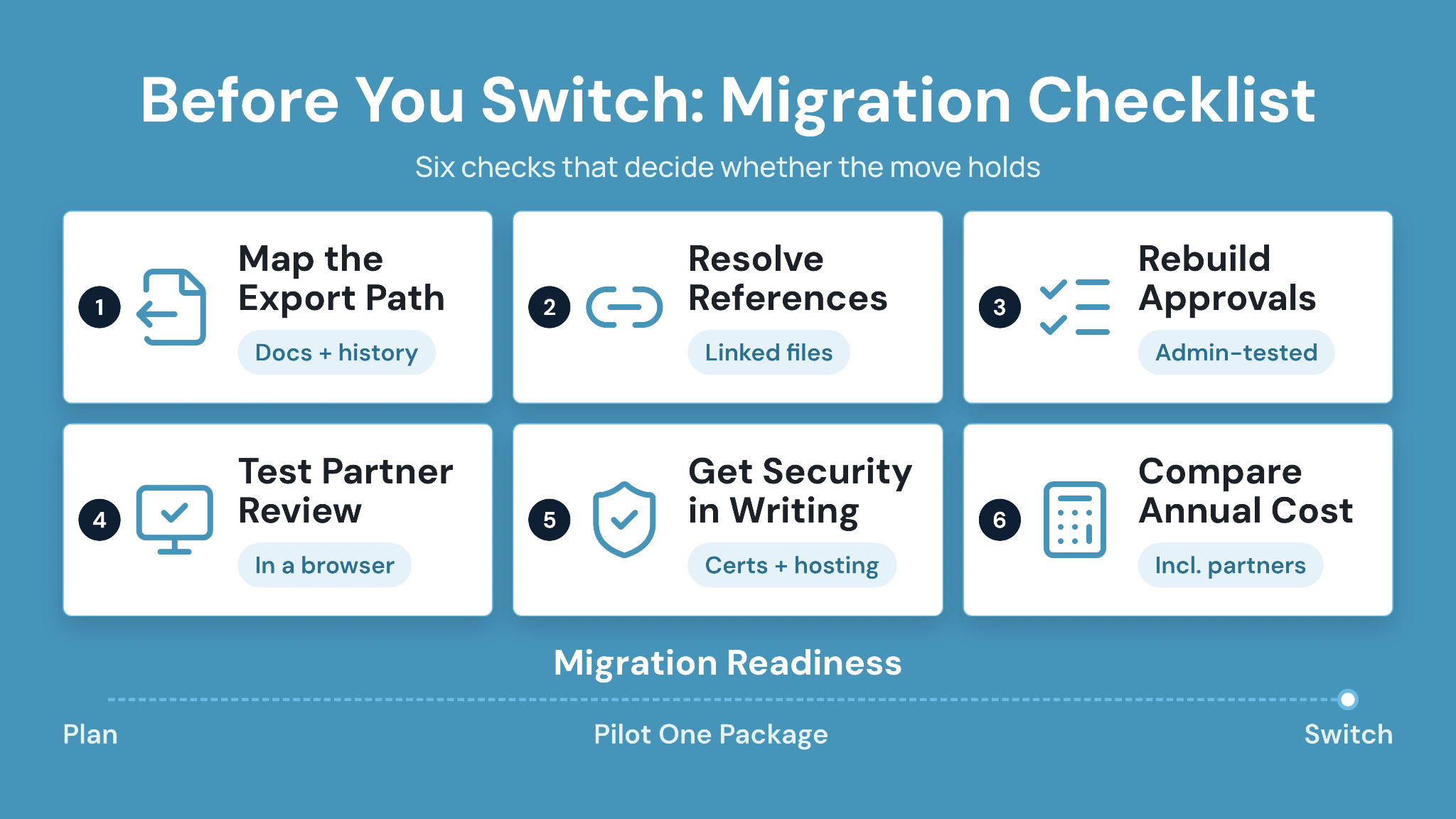
Migration checklist:
- Documents, revision history, and metadata have an export path and a destination.
- Linked reference files resolve in the new platform, or the team has a plan for them.
- Approval steps and statuses were rebuilt and tested by an admin.
- An outside firm opened files and completed a review in a browser.
- Security evidence and hosting terms arrived in writing.
- Every quote converts to one annual figure, including partner access.
ProjectWise Alternatives: Why CUBE Fits Best
CUBE fits mid-market engineering teams that need a governed record without a heavy deployment. Every firm works in a browser, every approval ties to the exact version, and transmittals record who received what. Teams centered on MicroStation reference files should test that workflow first.
Pilot CUBE on one live package with real reviewers and outside firms, and score it against the pilot scorecard above. For background, read our guides to the common data environment and construction document management.
SIGN UP to try CUBE on your next project.
Frequently Asked Questions
1. What should engineering teams look for in a ProjectWise alternative?
Look for governed revisions, approvals tied to exact versions, formal transmittals, and per-user permissions for outside firms. Then test browser access to CAD and BIM files, open-format issue exchange, and bulk migration of documents and metadata.
2. Which ProjectWise alternatives suit large owner programs?
CUBE suits mid-market teams that need a centralized platform, such as a CDE, to control workflows and documents. Oracle Aconex and Asite suit large owner programs that need one controlled record across many organizations. Autodesk Forma suits teams designing in Revit and AutoCAD. Pilot each one on a live package with outside firms before deciding.
3. What should I check before migrating from ProjectWise?
List the documents, revision history, metadata, workflows, and transmittals you must keep. Ask Bentley which records export and in what formats. Then test how linked references resolve and pilot the new platform on one package.
4. Can partner firms open CAD and BIM files in CUBE without a desktop client?
Yes. CUBE's Design Viewer opens Revit, IFC, and CAD files in any browser, with section planes and measuring tools. Merged Files combine models from different firms, and issues move between tools as BCF 2.1 or 3.0.
5. How do admins change approval workflows in CUBE?
Admins edit Review Flow templates in the Reviews module, setting up to 20 ordered levels with reviewers and conditions. They map each level to a Custom Status, such as an ISO 19650 state, and move files in bulk.
Notes and Trademarks
Trademark notice. Bentley®, ProjectWise®, and MicroStation® are registered trademarks of Bentley Systems, Incorporated. Oracle® and Aconex® are registered trademarks of Oracle and/or its affiliates. Asite® is a registered trademark of Asite Solutions Limited, and 3D Repo® is a registered trademark of 3D Repo Ltd. Autodesk®, Autodesk Construction Cloud®, Autodesk Forma®, AutoCAD®, and Revit® are registered trademarks, and Forma Build™ is a trademark, of Autodesk, Inc., and/or its subsidiaries and affiliates in the USA and other countries. Newforma® and Newforma Konekt® are registered trademarks of Newforma, Inc. Dalux® is a registered trademark of Dalux ApS. Trimble® and Trimble Connect® are registered trademarks of Trimble Inc. G2® is a registered trademark of G2.com, Inc. Capterra® is a registered trademark of Capterra, Inc. Software Advice® is a registered trademark of Software Advice, Inc. TrustRadius® is a registered trademark of T-Radius Holdings, Inc. Excel® and Windows® are trademarks of the Microsoft group of companies. IFC™ is a trademark of buildingSMART International Limited. BSI Kitemark™ is a trademark of The British Standards Institution. All other product names, logos, and brands are the property of their respective owners and appear on this page only to identify products and compatible software. CUBE is not affiliated with, sponsored by, or endorsed by Bentley Systems, Incorporated, Oracle Corporation, Asite Solutions Limited, 3D Repo Ltd, Autodesk, Inc., Newforma, Inc., Dalux ApS, Trimble Inc., G2.com, Inc., Capterra, Inc., Software Advice, Inc., T-Radius Holdings, Inc., Microsoft Corporation, buildingSMART International Limited, The British Standards Institution, or any other trademark owner named on this page.