


Online OBJ Viewer for Design & Construction Teams

Open a Wavefront OBJ mesh without modelling software. Choose your .obj and the model opens for you to view.

Upload any .obj up to 50 MB
No account required
No additional licenses required
OBJ
No file selected
Waiting for a file
↑

Drop a .obj File Here

Drag and drop your file or click the button below to upload it.

Choose OBJ File

.obj only, up to 50 MB. The geometry opens without its .mtl file.

60+
Formats CUBE can view in a project, with this page as the public .obj route
50 MB
Maximum .obj size this page accepts
0 licences
No modelling software needed. No account is required to open the model
14 days
How long a file on this viewer is kept before automatic deletion

How to Use This Online OBJ Viewer

Two steps from an exported .obj to a model you can review. The file is checked on your device, then it opens inside CUBE.

Step 1 of 2

Choose a .obj File

The browser checks the extension and size before anything leaves your device. Maximum size is 50 MB. Choose the .obj itself, not its .mtl material file.
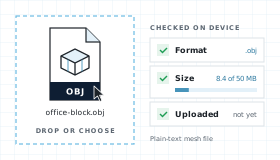
A .obj file dropped into the viewer and checked in the browser for format and size, still on your device
Step 2 of 2

View It in CUBE

The model opens in the CUBE viewer. Pan, zoom, fit. Upgrade to measure the model, share it, raise issues, and run reviews.
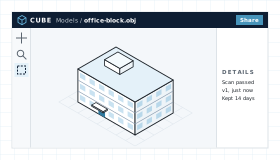
The file open in the CUBE viewer

What This OBJ Viewer Shows in a Model

OBJ is geometry first: points, faces, and the materials they name. There are no layers or sheets, so the Online OBJ Viewer is about looking at the shape.

Mesh Geometry

Faces and surfaces from the .obj, translated and shown in 3D. Pan, zoom, and fit to inspect the shape.

View Without a Licence

Open the file without modelling software.

Hand-off Into CDE

Your model is already stored in CUBE, not a throwaway preview. Upgrade and it becomes a controlled document with versions, reviews, and transmittals.

Measure, Share, and Issues

This page is the viewer. Upgrade to measure the model, share it, and raise tracked issues.

OBJ Viewer Workflow, Step by Step

Upload and preview your files, directly in the browser.

From Dropzone to Viewer

Four steps between choosing a file and working on it in CUBE.

01

Choose

Extension lock to .obj and size check at 50 MB, both in the browser. Nothing is uploaded yet.

02

Upload and scan

The file uploads for this viewing session, visible only to you. Malware scan runs before translation and fails closed.

03

Translate and view

The model translator used in Spaces renders the mesh. Pan, zoom, fit, and orbit. Measuring, sharing, and issues need an upgrade.

04

Keep or expire

Files are deleted after 14 days. Upgrading keeps them as controlled project documents.

What an OBJ File Contains

OBJ was created by Wavefront Technologies for its Advanced Visualizer software around 1990. It has lasted because almost every 3D tool can write it: modelling packages, scanning software, CAD/CAM systems, and renderers. On construction projects OBJ usually turns up as a massing study, a scanned surface, a visualisation export, or a manufacturer's product model.

An OBJ is plain text. Each line starts with a keyword: v for a vertex, vt for a texture coordinate, vn for a normal, and f for a face that joins vertices by their index. Materials live in a separate .mtl file that the OBJ names. This Online OBJ Viewer accepts the .obj itself, up to 50 MB.

OBJ Record Map

The keywords a translator reads to build the mesh, in the order they usually appear.

V

Vertices

Points in space, one per line, as x, y, and z. Everything else refers back to them.

VT

Texture Coordinates

Positions on a texture image, used when a material maps a picture onto the surface.

VN

Normals

Directions that tell the renderer which way each surface faces.

F

Faces

Polygons built from vertex numbers, counting from 1 in the order the vertices were written.

MTL

Materials

mtllib names the material file, and usemtl switches the material for the faces that follow.

Polygonal Mesh OBJ

Most OBJ files are polygon meshes: a list of vertices followed by faces that join them. Scanned surfaces can run to millions of faces, so check the 50 MB limit first.
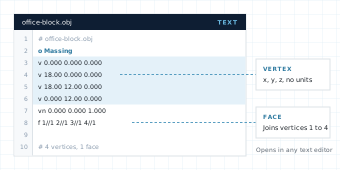
An OBJ file in a text editor: four v lines for vertices, one vn line for a normal, and an f line that joins vertices 1 to 4 into a face

OBJ With Materials

An OBJ can point to a .mtl file for colours, transparency, and texture images. Only the .obj uploads here, so expect the shape without its materials.
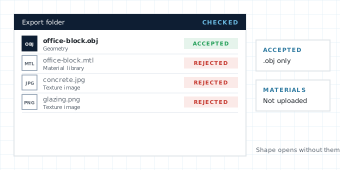
An export folder where the .obj is accepted and its .mtl material library and two texture images are rejected

Common records in an OBJ file:

v
vt
vn
vp
f
l
p
o
g
s
mtllib
usemtl
curv
curv2
surf
parm

Free-form curves and surfaces from older software, missing .mtl files, and broken texture paths can change how a model looks. The mesh that can be read still loads, and an unreadable file shows a parse error instead of a blank canvas.

OBJ Viewer Compared With Blender and Other Tools

Compare with in-browser parsers that never leave the tab and Blender, the free desktop modeller most people reach for next.

NeedCUBE OBJ ViewerIn-browser parserBlender
Open .obj without a licenceYes. No account and no modelling software.Yes. Most parsers read OBJ.Yes. Free, but a desktop install.
File leaves the deviceYes. Uploaded for viewing, scanned, and deleted after 14 days.Usually no. The file is parsed in the tab.No. Opens from local disk.
Matches project CDE previewYes. Same production translator.No. A separate engine.No. A separate desktop tool.
Inspect mesh geometryYes. Pan, zoom, fit, and orbit.Yes, for most meshes.Yes, with full 3D tools.
Edit geometryNo. View only.No.Yes. A full modeller.
Save into a controlled projectAlready stored in CUBE. Upgrade to keep and share.No CDE hand-off.No CDE hand-off.

Who Uses an OBJ Viewer on a Construction Project

OBJ files rarely start on a construction team. They arrive from a visualiser, a scanning contractor, or a manufacturer, and someone has to check them.

Visualisation

Architects and Visualisation Teams

Check a massing or visualisation export before it goes to the client, and check anything that came through wrong.
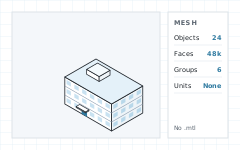
The file open in the CUBE viewer
Coordination

BIM and VDC Coordinators

Check incoming reference geometry, such as a scanned surface or survey mesh, before it is used alongside the design models.
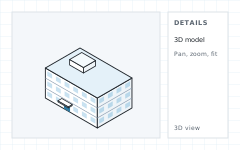
The file open in the CUBE viewer
Before ordering

MEP and Product Teams

Open a manufacturer's product model and confirm it is the right item before it goes into a design.
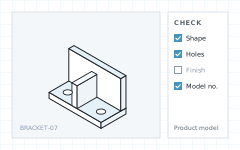
A steel bracket in 3D with one hole marked up and a short review checklist
Sign-off

Owners and Consultants

Look at a shared model without installing modelling software. Upgrade when the file should become part of the project record.
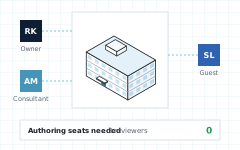

Three reviewers, an owner, a consultant and a guest, marking up one model with no authoring seats

OBJ Viewer FAQ

Do I need modelling software to use this OBJ viewer?

No. CUBE opens .obj files in Chrome, Edge, Firefox, or Safari. You do not need Blender, a plugin, or any modelling licence to look at the model.

Is the CUBE OBJ viewer free?

Yes. Viewing on this page is free. Measuring the model or other advanced actions needs an upgrade.

Does this OBJ viewer upload my file?

The browser checks the file first, then uploads it so it can be scanned and translated by CUBE’s production model engine.

What files does the Online OBJ Viewer accept?

.obj only, up to 50 MB. The .mtl material file and texture images are not uploaded, so the shape opens without them. FBX, GLB and glTF, and other formats have their own viewer pages.

Why does my OBJ look grey or untextured?

Colours and textures live in the .mtl file and the images it points to, not in the .obj. The Online OBJ Viewer opens the geometry, so the model shows without its materials.

Does the OBJ viewer edit the mesh?

No. Moving vertices, cleaning up faces, or saving a new OBJ is out of scope. Use a modelling tool for that.

Why is my model the wrong size?

OBJ stores numbers, not units. The same file can mean millimetres to one tool and metres to another, so check the scale with whoever exported it.

Notes and Trademarks

Trademark notice. Autodesk®, FBX®, and Revit® are registered trademarks or trademarks of Autodesk, Inc., and/or its subsidiaries and affiliates in the USA and other countries. glTF and the glTF logo are trademarks of The Khronos Group Inc. Blender is a registered trademark of the Blender Foundation. IFC is an open standard of buildingSMART International. Chrome, Edge, Firefox, and Safari are trademarks of their respective owners. All other product names, logos, and brands are the property of their respective owners and appear on this page only to identify file formats and compatible software. CUBE is not affiliated with, sponsored by, or endorsed by Autodesk, Inc., The Khronos Group Inc., the Blender Foundation, or any other trademark owner named on this page.

Use of this tool. Use of the CUBE OBJ Viewer does not require a CUBE account. It is subject to the CUBE Terms of Use and Privacy Policy. By uploading a file, you confirm that you own the file or are authorised to share it, and that it does not contain material you are not permitted to disclose. Files are used only to generate the preview and are handled as described above.

File retention. Uploaded files are deleted automatically 14 days after upload. You can delete a file yourself at any time before then. Paid plans keep files as controlled project documents.

Preview only. Rendered models are provided for reference. Some geometry, materials, textures, or linked content may not display exactly as in the authoring application. Do not rely on the preview for construction, fabrication, setting out, or measurement without checking the original file. The tool is provided as is, without warranty of any kind.

Availability. This tool is not offered in countries or regions subject to comprehensive U.S. or other applicable trade sanctions, or to persons on restricted-party lists.