






Procore Alternatives for Construction Teams
Compare 9 Procore alternatives by the reason you're switching, with review-based pros and cons, best-fit labels, and a switching-cost checklist.


TL;DR
- Procore alternatives make sense when a specific workflow drives the switch, such as document control, platform overhead, field adoption, or ERP-led cost control.
- Capterra reviewers praise Procore's centralized platform but report bugs, lag, and email overload, and several call it heavy for smaller teams.
- CUBE suits mid-sized AEC teams that need tighter drawing control, multi-level Review Flows, logged transmittals, and free Guest seats for partner firms.
- Autodesk Forma Build fits Autodesk-standardized contractors, while Oracle Aconex, InEight, and CMiC fit large capital programs and finance-led construction firms.
- Fieldwire suits field-first crews, while Buildertrend and Contractor Foreman suit home builders and small contractors that want simpler, lighter tools.
Procore® runs drawings, RFIs, submittals, daily logs, quality and safety, and construction financials in one system. For a large general contractor, Procore's breadth can justify its fee.
However, the fit changes for smaller and specialist teams. Procore prices each product on annual construction volume, has a steep learning curve, and is heavy on email notifications. For MEP and VDC teams, model work often sits in a separate BIM tool, and that’s where they start looking for Procore alternatives.
Teams base their decision on three factors: pricing they can afford, a platform sized to their work, and tighter control of drawings and models across firms. CUBE leads this list for mid-sized teams that need tighter document control with less platform overhead. Autodesk® Forma Build™ suits Autodesk-standardized contractors, and Fieldwire® suits field-first crews.
This guide compares nine Procore competitors on document control, field use, cost tracking, partner access, and the type of team each one suits.
Best Procore Alternatives at a Glance
The best Procore alternative depends on why you're switching. CUBE fits teams switching for document control and partner access. Autodesk Forma Build fits contractors standardized on Autodesk tools. Oracle® Aconex®, InEight®, and CMiC® fit large programs and finance-led firms, while Fieldwire, Buildertrend®, and Contractor Foreman™ fit field crews, home builders, and small contractors.
Why Teams Consider Switching from Procore
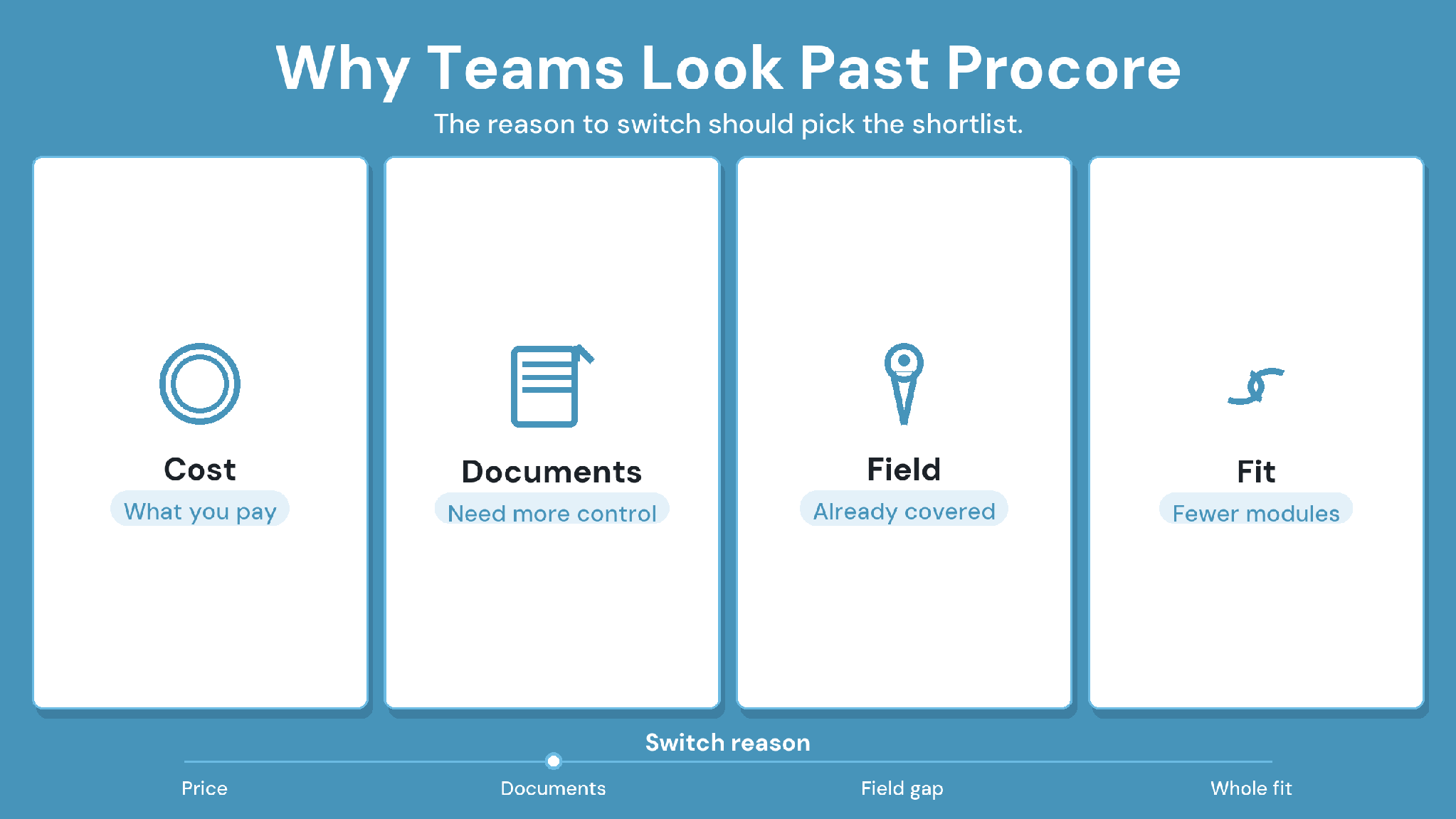
Procore earns its place with large general contractors that run many commercial jobs and have project-controls staff to configure it. Plenty of mid-size AEC teams don't work that way, and that's where the fit starts to slip. In Procore reviews on Capterra, four reasons appear most often.
1. Cost tracks construction volume instead of usage
Procore charges an annual fee per product, based on annual construction volume. Win more work, and the bill rises, even if your team uses the platform the same way. That makes software cost hard to model before a sales call.
2. The platform is built for scale
Several reviewers describe a steep learning curve and say the cost suits large, high-volume contractors better than smaller firms. Admins configuring permissions, integrations, and workflows need extra time, and some reviewers find permissions confusing or not flexible enough.
3. Day-to-day friction adds up
Reviewers report bugs, glitches, and lag, sometimes at peak hours. Others find email notifications excessive and hard to tune, especially across many projects.
4. Model-heavy work needs another tool
Some MEP reviewers say Procore depends on outside BIM tools for model work. For VDC teams, that means a second platform for federated models and version comparison.
These points don't make Procore a weak product. They make it a harder fit when your costliest problems are drawing control, approvals, and model coordination across firms.
How We Compared Procore Alternatives
A Procore alternative has to cover the workflows your team runs today and fix the one pushing you to switch. We compared each platform on eight buyer-facing criteria. Features come from each vendor's own pages, and strengths and tradeoffs reflect recurring themes in G2® and Capterra reviews from 2023 onward.
The 9 Best Procore Alternatives Compared
Each platform below answers a different reason for leaving Procore. CUBE comes first because this is CUBE's guide; the rest run from broad platforms to lighter tools.
1. CUBE: Best for Document Control With Less Platform Overhead
CUBE is a construction project management platform that pairs a common data environment with a Project Management product. The common data environment handles versioned drawings, Review Flows, and transmittals. Project Management adds schedules, estimates, contracts, progress updates, and inspections for mid- size AEC teams working across several firms.
CUBE is best for
Specialty and MEP subcontractors, mid-size general contractors, and BIM or VDC consultancies that want controlled drawings, traceable approvals, and easy partner access.
CUBE's key features
Every upload becomes a new version automatically, and a configurable revision series marks the versions you issue.
Review Flows in the Reviews module run up to 20 ordered levels, each assigned to its own reviewers. Admins create custom statuses, such as ISO 19650 states, in Portal Settings and add them to each Review Flow, where transitions set how files can move between them. Files can be moved to a new status one at a time or in bulk.
The Transmittals module keeps a complete record of sender, recipients, timestamps, and files.
The Folders module holds each project's Spaces, with Project Roles, Space- level permissions, and six access levels on any file or folder.
Nomenclature templates set the naming every new subfolder must follow, and an Excel® template bulk-uploads files and later versions with their metadata.
The Design Viewer opens Revit, IFC™, and CAD files in any browser, including on tablets and phones, with section planes and measuring tools.
Merged Files combine several models into one federated view, and BIM and CAD compare show any two versions side by side.
Issues pin to PDF, CAD, and BIM files and move in and out as BCF files. A Revit plugin syncs them back with persistent element IDs.
PDF stamps and signatures carry the user's name and a timestamp, and QR codes on printed sheets let crews check whether a sheet is current.
Schedules with Gantt charts, Estimates, Contracts with budgets, Progress Updates, and Inspections run in the Project Management product.
ISO 27001, SOC 2 Type II, and the BSI Kitemark™ for BIM software, certified against ISO 19650.
How CUBE solves Procore's pain points
Cost that tracks volume: CUBE publishes per-user pricing for each product, so you can model a project's software cost before a sales call.
Permissions that confuse: Project Roles set what each person can do, and Space-level permissions set default access by module. Six access levels then apply to any file or folder, and a file-level setting overrides its folder.
Model work in another tool: Merged Files federate models in one browser view, and BIM and CAD compare show what changed between versions. Issues move to Revit through BCF and the Revit plugin.
Drawing control across firms: Review Flows tie each decision to the exact version reviewed, and transmittals record who received what and when. On site, a QR scan tells crews whether a printed sheet is current.
CUBE's strengths
Federated models and version comparisons sit in the same platform as drawing control.
Approvals stay tied to the exact version, with a full transmittal record behind them.
Partner firms join on free Guest seats as the paid team grows.
CUBE's tradeoffs
Clash Detection is a paid add-on, currently in beta.
Field-only punch-list crews and residential builders fit better with tools built for that work.
CUBE's pricing
Published per-user pricing for each product, billed monthly or annually, on CUBE's pricing page.
Case in point: a global design consultant
The consultant replaced siloed tools with a centralized common data environment in CUBE. Teams ran integrated multi-team review workflows and simplified their Transmittals. Read the full case study →
2. Autodesk® Forma® Build: Best for Autodesk-Standardized Contractors
Forma Build, formerly Autodesk Build, is the construction management product inside Autodesk Forma®, which replaced the Autodesk Construction Cloud® name on March 24, 2026. It covers field execution, RFIs, submittals, schedules, and cost management, all tied to Autodesk design data from Revit and AutoCAD.
Autodesk Forma Build is best for
General contractors and design-build firms that author in Revit and AutoCAD.
Autodesk Forma Build's key features
Punch lists, issues, daily reports, forms, photos, and models for field execution
RFIs, submittals, specifications, meetings, and correspondence
Schedule management and work planning
Budget management, contract administration, change management, and payment applications
Version control, reviews, and transmittals for project files
Autodesk Forma Build's strengths
Collaboration tools keep teams and files in sync.
Gives quick access to current documents on site.
Covers construction work end to end in one comprehensive platform.
Autodesk Forma Build's tradeoffs
Performance slows down, especially with large files.
Syncing can be slow or manual.
Technical glitches can interrupt workflows.
Autodesk Forma Build's pricing
Per-user monthly and annual plans on Autodesk's product page, with unlimited- user pricing on quote.
3. Oracle Aconex: Best for Large Multi-Party Programs
Aconex is Oracle’s cloud platform for large construction and engineering programs. It keeps documents, project mail, and workflows in one controlled record that every organization on the program works inside, with field management and project controls alongside.
Oracle Aconex is best for
Owners, EPC firms, and infrastructure teams where a client or program requires every firm to work in one controlled record.
Oracle Aconex's key features
A complete project record across the construction lifecycle
Project mail for formal correspondence
Design and construction coordination with BIM model access
Field management with issues, inspections, punch lists, and daily reports
Project controls
Oracle Aconex's strengths
Strong document control and workflow management.
Keeps a clear record of every document approval.
Responsive direct support contacts.
Oracle Aconex's tradeoffs
The layout feels clunky, and the learning curve is steep.
Workflows merge multiple comments on a sheet into one.
Mail has no workflows and is hard to report on.
Oracle Aconex's pricing
Available on quote from Oracle.
4. Trimble ProjectSight: Best for Contractors on Viewpoint Accounting
ProjectSight is Trimble’s project management software for commercial general contractors. It brings documents, drawings, RFIs, submittals, and photos into one place, and connects project data with Trimble’s Viewpoint Vista and Spectrum accounting systems.
Trimble ProjectSight is best for
Mid-market commercial contractors that run Viewpoint Vista or Viewpoint Spectrum for accounting.
Trimble ProjectSight's key features
Documents, drawings, RFIs, submittals, and photos in one location
Field and office connection for real-time financial and project control
AI-assisted drawing uploads and linked project information
Web, iOS, and Android™ apps
Trimble ProjectSight's strengths
Provides a solid project management backbone for general contractors.
Connects project data with Viewpoint accounting.
Trimble ProjectSight's tradeoffs
Not every desktop feature works in the mobile app.
Support during rollout can fall short.
Adoption and training take time.
Trimble ProjectSight's pricing
Available on quote from Trimble.
5. InEight: Best for Capital Project Controls
InEight is a modular project controls platform for capital, infrastructure, and heavy civil projects. Its modules cover estimating, CPM scheduling, cost control, contracts, change, work packaging, and document control, and teams buy only the modules they need.
InEight is best for
Infrastructure, heavy civil, and capital project teams with a mature project-controls function.
InEight's key features
Control, with budget and forecast scenarios that integrate with your ERP
Contract and Change modules for contracts, payments, issues, and change orders
Plan and Progress for work packages and real-time productivity
Estimate, plus Schedule with full CPM, look-ahead planning, and risk management
Document and Model modules for document control and a common data environment
InEight's strengths
Keeps project information in one place across the lifecycle.
Links project controls, scheduling, and field data.
InEight's tradeoffs
Heavy to implement without a mature project-controls team.
InEight's pricing
Available on quote; InEight prices by the modules you choose.
6. CMiC: Best for ERP-Led General Contractors
CMiC is a construction ERP that puts financials, project management, and project controls on a single database. Large general contractors use it to run accounting, job costing, and project operations from one system.
CMiC is best for
Large general contractors and capital project firms whose finance team wants accounting and project management on one database.
CMiC's key features
A single database platform for Financials, Project Management, and Project Controls
Construction accounting and job costing
Field management tied to the same data
CMiC's strengths
Combines project management and accounting in one integrated ERP.
Offers a deep feature set that rewards long-term use.
CMiC's tradeoffs
Some features don't always work smoothly.
Support and accounting integrations rate below rival tools on G2.
CMiC's pricing
Available on quote from CMiC.
7. Fieldwire by Hilti: Best for Field-First Crews
Fieldwire is a jobsite management app that runs tasks, punch lists, inspections, and markups directly on project plans. Crews use it on mobile and web, and a free Basic plan covers up to five users.
Fieldwire is best for
Superintendents, field crews, and specialty contractors who use Procore mainly for plans, tasks, and punch lists.
Fieldwire's key features
Plan viewing and markups on mobile and web
Tasks, punch lists, and inspections linked to drawings
A BIM viewer from the Business tier
RFIs, submittals, change orders, and budgets on the Business Plus tier
Fieldwire's strengths
Easy interface for crews who aren't tech-savvy.
Links tasks and markups to drawings.
Fieldwire's tradeoffs
Limited links to job management systems.
Office workflows sit on the top tier.
Fieldwire's pricing
Free Basic plan for up to five users, then per-user paid tiers on Fieldwire's pricing page.
8. Buildertrend: Best for Home Builders and Remodelers
Buildertrend is project management software for home builders and remodelers. It covers lead proposals, client selections, scheduling, change orders, daily logs, and a client portal, with QuickBooks®, Xero®, and Gusto® integrations.
Buildertrend is best for
Home builders and remodelers whose work centers on client selections, change orders, and schedules.
Buildertrend's key features
Lead proposals and client selections
Advanced estimating on higher plans
QuickBooks, Xero, and Gusto integrations
Scheduling, daily logs, and a client portal
Buildertrend's strengths
Puts scheduling, budgets, and client updates in one place.
Includes unlimited users and subcontractors.
Buildertrend's tradeoffs
The feature set can feel overwhelming at first.
Thin links to ERP and accounting tools.
Scheduling can be too simple for larger commercial jobs.
Buildertrend's pricing
Three published plans, Essential, Advanced, and Complete, on Buildertrend's pricing page.
9. Contractor Foreman: Best for Small General and Trade Contractors
Contractor Foreman is an all-in-one platform for small general and trade contractors. It combines estimates, schedules, change orders, daily logs, timecards, and a client portal in one tool, sold on tiered plans with a 30-day free trial.
Contractor Foreman is best for
Small general and trade contractors that need office tools without an enterprise contract.
Contractor Foreman's key features
Estimates, schedules, and change orders
Daily logs and timecards
A client portal
Contractor Foreman's strengths
Easy to use, with solid mobile access.
Responsive support.
Contractor Foreman's tradeoffs
Integration problems, especially with QuickBooks.
Limited customization.
Contractor Foreman's pricing
Published tiered plans with a 30-day free trial as per the G2 pricing page.
Procore vs CUBE: Six Reasons Teams Switch
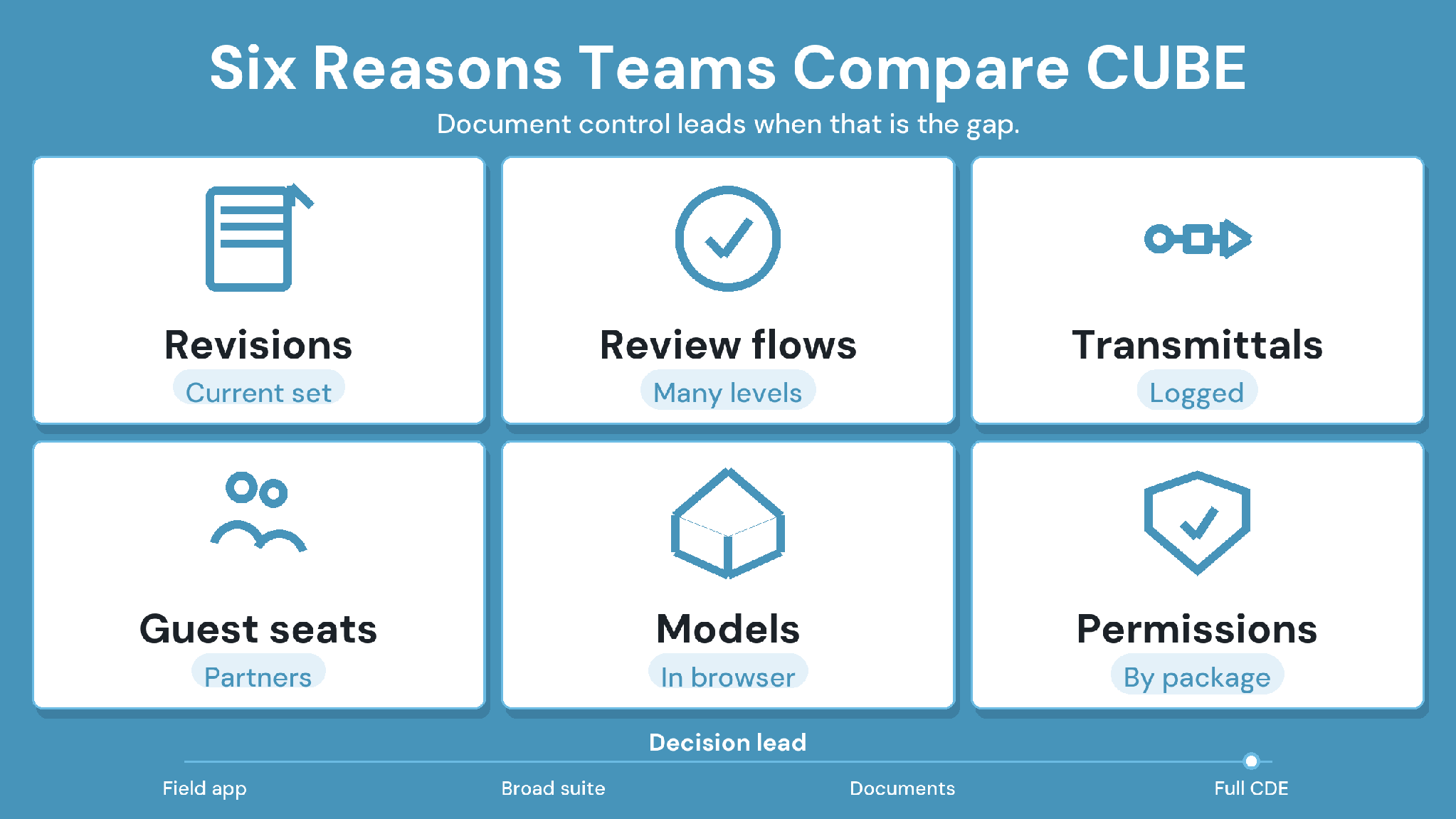
Procore covers a broad general-contractor scope, while CUBE goes deepest on the document record, model coordination, and partner access. These six areas decide most switches.
1. Pricing model
With Procore: an annual fee per product, based on annual construction volume. The bill grows as your work grows.
With CUBE: published per-user pricing for each product, billed monthly or annually. You can model the cost before a sales call.
2. Model coordination
With Procore: some MEP teams pair it with outside BIM tools for model work.
With CUBE: Merged Files federate models in one browser view, and BIM and CAD compare show what changed between versions. Issues move to Revit through BCF 2.1 or 3.0 and the Revit plugin.
3. Approval traceability
With Procore: approval workflows across drawings, RFIs, and submittals.
With CUBE: Review Flows of up to 20 ordered levels record each decision against the exact version. Custom Statuses, such as ISO 19650 states, map onto review levels and move in bulk.
4. The current sheet on site
With Procore: mobile access to drawings and reports.
With CUBE: a crew scans the QR code on a printed sheet to see whether it is current or superseded, then downloads the latest version.
5. Permissions
With Procore: some reviewers find permissions confusing or not flexible enough.
With CUBE: Project Roles, Space-level permissions, and six access levels per file or folder. A file-level setting overrides its folder.
6. Filing discipline and migration
With Procore: folder structures and naming depend on project setup; test both in a demo.
With CUBE: Nomenclature templates set the naming every new subfolder must follow. An Excel template bulk-uploads files and later versions with their metadata, which also speeds a move from another platform.
Stay with Procore if your team depends on a broad general-contractor scope, construction financials, and unlimited internal users across many jobs.
Move to CUBE if drawing errors, approval traceability, or model coordination cost you most, and you want predictable per-user pricing.
How to Evaluate a Procore Alternative
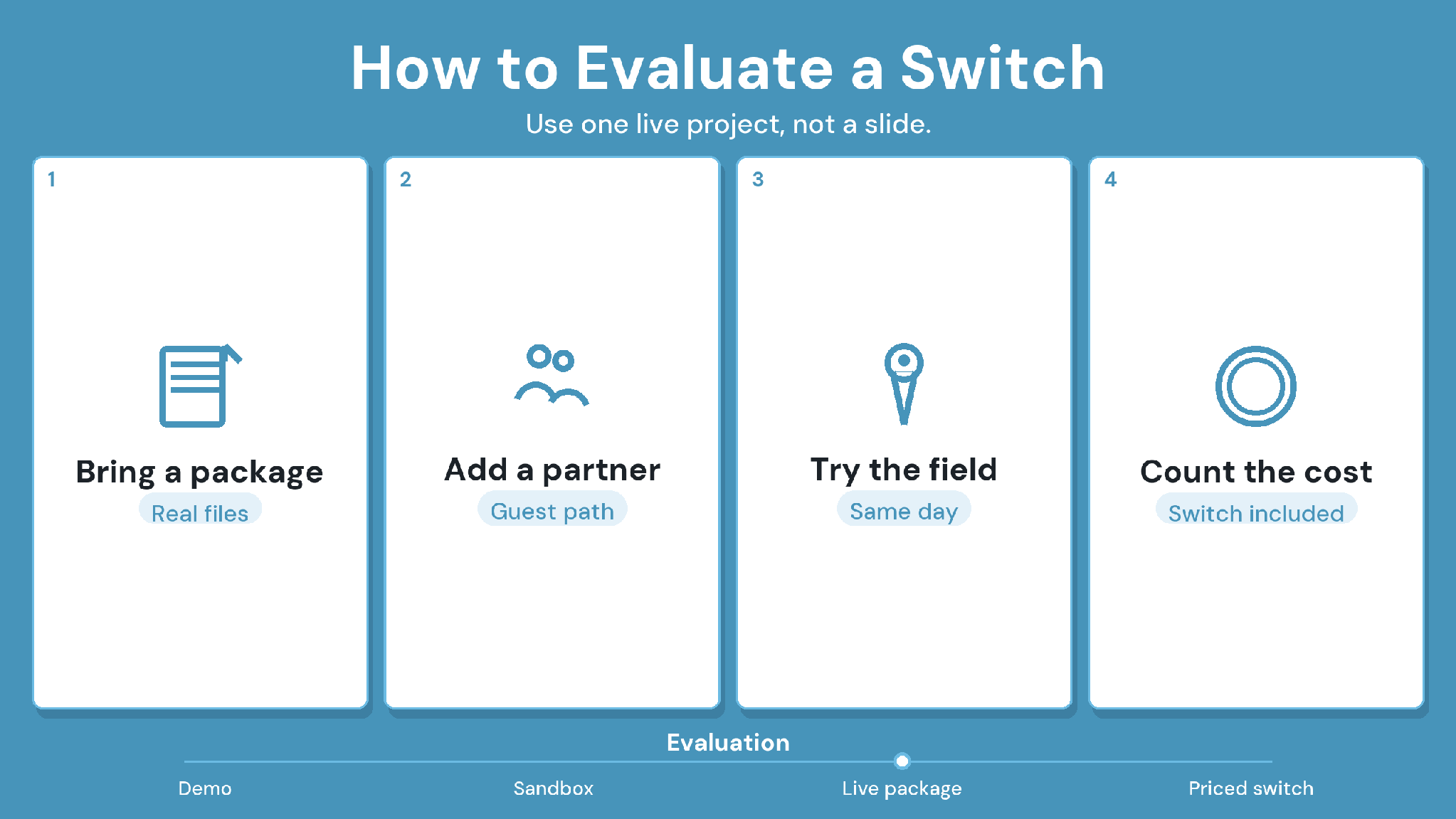
Evaluate a Procore alternative against the workflow you are switching from, then count the full switching cost. Check which Procore records must move, which integrations must keep working, how partners get access, and whether crews adopt the new tool. Verify every price with the vendor directly.
1. Rank the workflows you can't lose
Procore teams often depend on RFIs, submittals, daily logs, budgets, and change orders. List which ones the new platform must handle on day one, and which can live in another tool. A platform without native RFIs can still work if your RFIs run elsewhere.
2. Map the migration
Ask Procore which project records export and in what formats. Decide what moves: current drawings, revision history, open RFIs and submittals, daily logs, and photos. Archive closed projects before you migrate live ones.
3. Test integrations with real data
Accounting, ERP, scheduling, and design-tool connectors decide whether a switch sticks. Run the exact connector you need during the pilot, using a real cost code or drawing set.
4. Rebuild permissions before go-live
Write down who sees what today, including owners, designers, subcontractors, and field crews. Then rebuild those roles in the new platform and test each one with a real user.
5. Pilot for adoption
Run one live project with at least one outside firm. Ask a superintendent and a subcontractor to finish a daily task without help, and track how often the office has to step in.
6. Verify pricing on the same basis
Procore prices on annual construction volume, while many alternatives price per user or per company tier. Convert every quote to one annual figure that includes partner seats, add-ons, and renewal terms.
Switching-cost checklist:
Every must-keep Procore record has an export path and a destination.
Open RFIs, submittals, and change orders have an owner during cutover.
Accounting and scheduling connectors worked with real data in the pilot.
Roles and permissions were rebuilt and tested with real users.
Field users completed a daily task on mobile without help.
Every quote converts to one annual figure with partner seats and add-ons.
Training time and internal admin hours sit in the budget.
When CDE and Document Control Should Lead the Decision
Document control should lead your Procore replacement decision when drawing errors cost more than any other workflow. Typical signs include rework traced to superseded sheets, approvals nobody can locate, and partners working from email attachments.
A common data environment (CDE) keeps one governed copy of every project file, with versions, review states, and issue records attached. In CUBE's Reviews module, you select the exact file version under review and set the order of reviewers. Each reviewer records a decision and comments against that version, so every response stays with the revision it was made on.
Partner access matters as much as control. Free Guest seats let designers and subcontractors review files in the same record, without a seat purchase for every outside user.
Let a broader platform lead when your switching reason is financials, ERP, or native RFI and submittal logs. Some teams pair a CDE with a separate financial system instead. For background, read our common data environment guide and our guide to construction document management.
Procore Alternatives: Why CUBE Fits Best
CUBE fits mid-size AEC teams that want tighter document control with less platform overhead. It versions every upload, runs Review Flows of up to 20 levels, and logs every transmittal. Every 10 CDE seats include 10 free Guest seats for partner firms. Clash Detection is a paid add-on, currently in beta.
Pilot CUBE on one live project with the drawings that cause the most rework, and score it against your switching-cost checklist.
SIGN UP to try CUBE on your next project.
Frequently Asked Questions
1. What are the best Procore alternatives for mid-sized contractors?
CUBE suits mid-sized teams switching for document control and partner access. Autodesk Forma Build suits Autodesk-standardized contractors, and Trimble ProjectSight suits firms already buying from Trimble. Pick by the workflow that is driving your switch.
2. Are there affordable Procore alternatives?
Fieldwire offers a free Basic plan for up to five users, and Contractor Foreman publishes tiered plans with a free trial. CUBE publishes per-user pricing and adds free Guest seats. Compare full annual cost on the same basis.
3. Is Autodesk Construction Cloud a good Procore alternative?
Autodesk Construction Cloud became Autodesk Forma on March 24, 2026, and Autodesk Build became Forma Build. It suits Revit and AutoCAD teams. Capterra reviewers report lag with large files and slow syncing, so test both in your pilot.
4. What should I check before switching from Procore?
List the Procore records you must keep, such as drawings, RFIs, submittals, daily logs, and photos. Ask Procore which export and in what format. Then test integrations, rebuild permissions, and pilot the new tool on one live project.
5. How does CUBE's pricing differ from Procore's?
Procore charges an annual fee per product, based on annual construction volume, with unlimited users included. CUBE publishes per-user pricing for each product, billed monthly or annually, and adds 10 free Guest seats per 10 paid seats.